


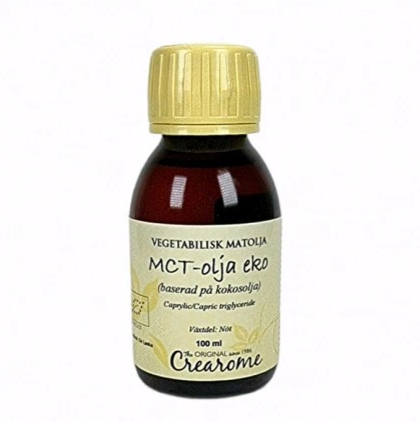

MCT Oil Org. 100ml, Crearome
119 SEK
In Crearomes MCT oil the fatty acids come from coconut oil. MCT oil is an easy and quick way to get energy without eating sugar or carbohydrates. MCT oil is usually used for weight loss or in physical training as it gives quick energy and increased fatburning capacity. MCT oil is also used in cooking and can replace other oils.
✓ Organic ✓ Gluten Free ✓ Lactose Free ✓ Heavy Metal Tested ✓ Vegan
✓ Organic ✓ Gluten Free ✓ Lactose Free ✓ Heavy Metal Tested ✓ Vegan
- Secure (SSL encryption) payments with Card, Klarna or Swish
- Quick delivery with DHL & PostNord
- Any questions? Please mail us at kundservice@ayurvedabutiken.se
Description
Article no.: 1538
Description:
MCT oil with fatty acids from coconut oil. MCT oil can be used as massage oil / skin oil. Unlike coconut oil, MCT oil is liquid and not a solid fat. The oil provides glide, softens and protects the skin and does not feel sticky as it goes into the skin faster. It can also be used in do-it-yourself products such as facial oils, lip serums, ointments and creams.
As food, these short-chain fatty acids have different advantages compared to longer-chain fatty acids:
They are absorbed by the body without the need for bile and go directly from the intestine to the blood on their way to the liver. In the liver, the fatty acids are converted into energy in the form of ketones, which the body/brain easily uses as energy. MCT oil is thus an easy and fast way to get energy without eating sugar or carbohydrate-rich foods. MCT oil can provide quick energy. You can use MCT oil in cooking to replace other oils/fats.
MCT is an abbreviation of Medium Chain Triglycerides, i.e. saturated short-chain fatty acids with 8 and 10 carbon atoms. In this MCT oil, the fatty acids come from coconut oil - (Cocos Nuciferta L). By physical methods, the saturated fatty acids with 12-18 carbon atoms are separated and the polyunsaturated & monounsaturated fatty acids are removed.
The difference between coconut oil and MCT oil looks like this:
C 8-0 Caprylic acid 8% - 57%
C10-0 Capric acid 6% - 42.7%
C12-0 Lauric acid 48% - 0,2%
C14-0 myristic acid 18%
C 16-0 palmitic acid 9%
C 18-0 stearic acid 3%
C18-1 oleic acid 9%
C18-2 linoleic acid 2%
Caprylic and capric acids are uncommon and are found almost exclusively in coconut oil. Like other saturated fatty acids, they are stable to rancidity - but the longer the saturated carbon chain, the better the shelf life!
Nutritional value 100 grams
Energy 3700KJ/900 kcal
Fat 100 gr
Spring of saturated fatty acids 100 grams
Carbohydrates 0 grams
Protein 0 grams
Salt 0 grams